Hubris & Rooftops

Many conversations I’ve had recently have been shadowed by a broad and crushing uncertainty. Regardless of the context, nearly every conversation seems to come back to the odds of The Machine Doing Everything. My friends, tennis coach, safari guide, parents, Uber driver, and waiter at my favorite sushi restaurant have brought up exponential AI progress. There are worrisome political trends hyperbolizing the technology and its effect on the climate, as well as the occasional TikTok of someone talking to ChatGPT as a romantic partner. This Elephant is understandable, as it definitionally sits in every Room. And the models are undeniably getting better over time, in ways that are hard to predict and understand.
There is the obvious frailty and dispiritedness that this sows in one’s perspective. Yet I won’t argue that the models are just another tool, like every technology past. They’re clearly something that we’ve never wielded before, and as an engineer and researcher, I’d be lying to say that the nature of my daily work has not metamorphosed in the last two years. I talk to synthetic intelligence every day, and 90% of my occupation now lives in a text box that I continually replenish with keystrokes. How absolutely wild.
Sometimes, though, I peer out the window of the tall building in the heart of San Francisco from which I work. I see a beautiful peregrine falcon perched nearby, or a small murmuration of resident European starlings, and I feel deeply humbled.
A peregrine falcon came to say hi pic.twitter.com/8RZeQ8WDwo
Adham (@adhamelarabawy) October 5, 2026
My gaze then shifts downwards, and I find myself looking for the occasional rooftop oasis in an ocean of buildings. I wonder why only tens of the hundreds of buildings below me have some sort of chair or patch of turf on their rooftops. Do they not know the beautiful views they possess? Is construction on top of these buildings somehow more difficult than building the office itself? Does furnishing a rooftop require some abundance of resources (time, money, effort, thinking) that our current economies cannot reliably produce?
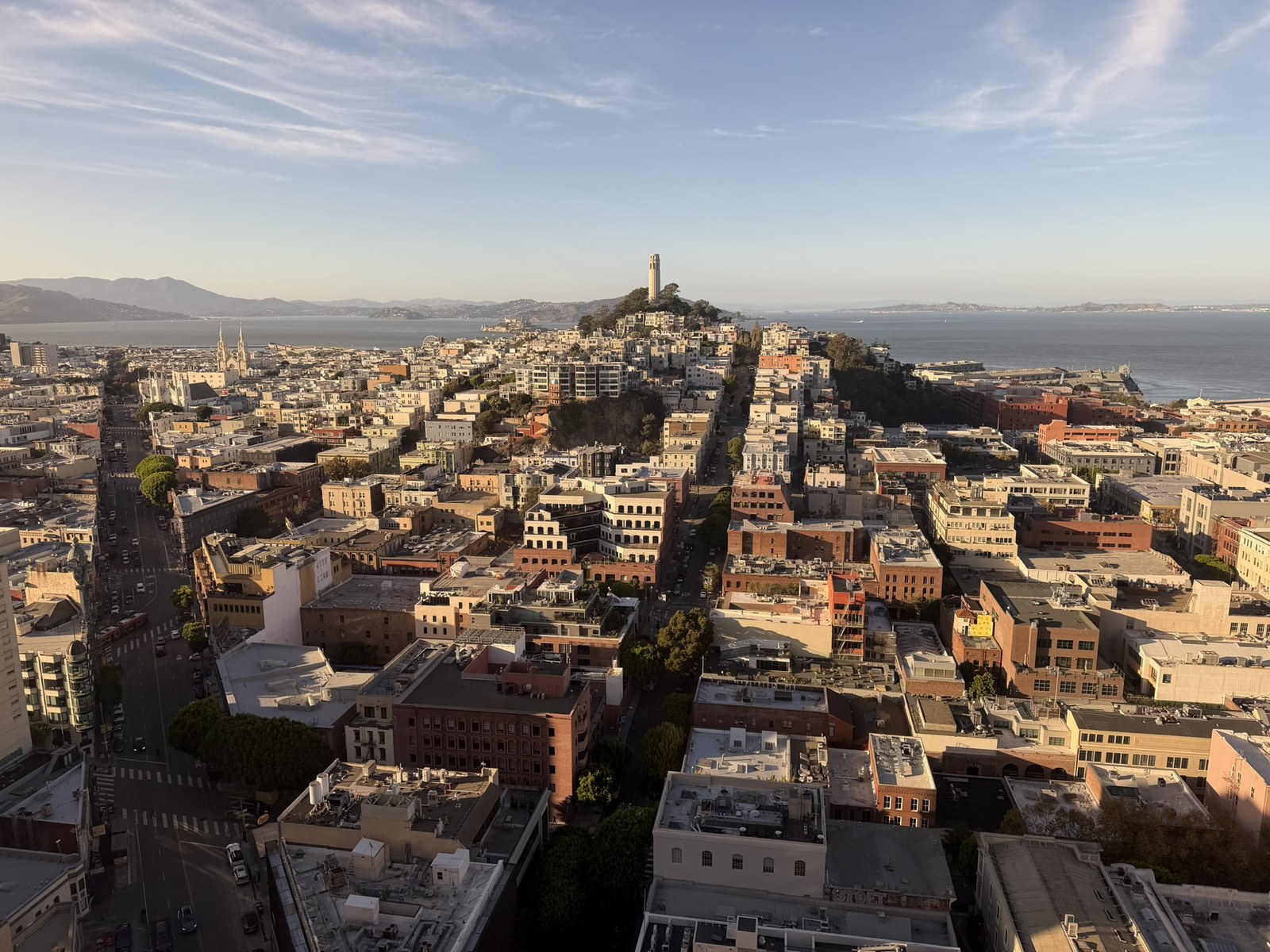
I know that the humans in each of these buildings would absolutely enjoy eating their lunch on a sunny rooftop. And yet, they don’t. I also know that if they were to look up at the European starlings, they’d be struck with awe. That they’d have an irreducible feeling inside them that would strike them down with humility.1
How humbling is it to know that the world we live in is infinitely more complicated than we could dream to understand and systematize? What hubris makes us think that we’ve accidentally Solved Everything? The physical world is clearly so much more complex than we’ve deluded ourselves into thinking it is. And yet our folly deceives us into believing that solving verifiable abstract logic (read: mathematics, coding) means we’re almost done solving Everything (read: the fullness of complexity of the real world and human coordination).
I’ve long admired the idea of Knightian Uncertainty. It concedes that there are situations too novel, complex, and unique to assign any reliable probability to. And what is the real world but infinitely novel, complex, and unique?
1 My wife would like to point out that not everyone wants to have an existential experience looking at birds. And that not everyone likes the sun in their face when biting into a sandwich. ↩
Preview footage: starling murmuration by Karen Roe, CC BY 2.0. Trimmed, muted, and resized.